


 PLATFORM UPDATE:

Defect engineering of MoS2/borophene/WS2 sandwich heterostructures enhanced the HER catalytic activity and improved water splitting efficiency
 *a
and
I. P.
Jain
b
*a
and
I. P.
Jain
b
Abstract
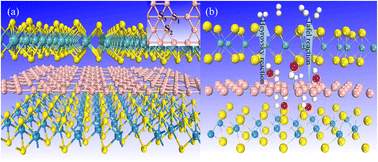
To enhance the stability of borophene and improve its catalytic activity for the HER, we have proposed a MoS2/borophene/WS2 sandwich structure and have systematically examined the influence of defect morphology on its catalytic properties. Furthermore, the influence of five intrinsic defects on the HER catalytic activity at the interface of the MoS2/borophene/WS2 heterojunction has been studied. To estimate the HER catalytic properties of the heterojunction, we calculated the dissociation energy barriers of water molecules over the S-vacancy-containing MoS2/borophene/WS2 heterojunction and systematically analyzed the energy barriers with three potential dissociation pathways. The results demonstrate that the MoS2/borophene/WS2 sandwich structure substantially improves the stability of the 2D-borophene structure. Note that the MoS2/borophene/WS2 heterojunction with S-vacancies exhibited excellent catalytic properties, demonstrated by the calculated ΔGH* of only −0.01 eV. This value is considerably lower than that of Pt and the borophene/WS2 heterojunction, highlighting its enhanced catalytic efficiency. In particular, due to the synergistic effect between borophene and defective WS2, the dissociation energy of water molecules was reduced to 0.71 eV. As a result, we propose that this MoS2/borophene/WS2 heterojunction not only demonstrates excellent HER catalytic activity but also effectively lowers the energy barrier for water dissociation in alkaline or neutral conditions. This advancement provides critical support for facilitating the practical application of borophene as an efficient HER catalyst.
 Please wait while we load your content...


