Issue 43, 2025

Lowering the sulfur density at the margins to trigger molybdenum disulfide nanoarray growth into branches to boost their hydrogen evolution reaction activity

Abstract

The planting of molybdenum disulfide (MoS2) nanoarrays on a specific substrate can be realized in 1 minute via dynamic magnetic fields. The high-quality MoS2 nanoarrays were vertically standing on the substrates. Decreasing the S/Mo ratio can increase the active edges of MoS2 nanoarrays. Additionally, hydrogen etching favors the increased formation of MoS2 edges during the growth process. The thus-obtained MoS2 nanoarrays exhibited excellent HER performance, with a geometric catalytic current density of 100 mA cm−2 at an overpotential (η) of 238 mV. In addition, the structure of the catalyst electrode remains stable after a 24 hour chronoamperometric (CP) test at 100 mA cm−2.
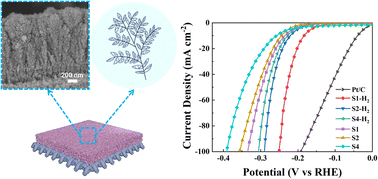
Graphical abstract: Lowering the sulfur density at the margins to trigger molybdenum disulfide nanoarray growth into branches to boost their hydrogen evolution reaction activity

Supplementary files

Transparent peer review

To support increased transparency, we offer authors the option to publish the peer review history alongside their article.

View this article’s peer review history

Article information

Article type
Communication
Submitted
21 Jul 2025
Accepted
06 Oct 2025
First published
07 Oct 2025

J. Mater. Chem. A, 2025,13, 36968-36974

Lowering the sulfur density at the margins to trigger molybdenum disulfide nanoarray growth into branches to boost their hydrogen evolution reaction activity

R. Qi, X. Qiao, J. Hou, T. Zhang, J. Liu, Q. Liu, F. Gao and Q. Huang, J. Mater. Chem. A, 2025, 13, 36968 DOI: 10.1039/D5TA05873B

To request permission to reproduce material from this article, please go to the Copyright Clearance Center request page.

If you are an author contributing to an RSC publication, you do not need to request permission provided correct acknowledgement is given.

If you are the author of this article, you do not need to request permission to reproduce figures and diagrams provided correct acknowledgement is given. If you want to reproduce the whole article in a third-party publication (excluding your thesis/dissertation for which permission is not required) please go to the Copyright Clearance Center request page.

Read more about how to correctly acknowledge RSC content.

Social activity

Spotlight

Advertisements