


 PLATFORM UPDATE:

Morphological insights into Se-driven charge transport and enhanced performance in Sb2(S,Se)3 solar cells

Abstract
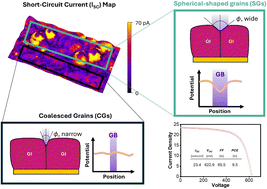
Sb2(S,Se)3 is a promising absorber for thin-film photovoltaics (PVs), yet its power conversion efficiency (PCE) remains limited. A key challenge lies in understanding the irregular grain morphology commonly found in these films, with their morphology-dependent electronic properties not being fully elucidated. Here, we investigate how Se incorporation alters grain structure and electronic properties in hydrothermally grown Sb2(S,Se)3 films. Selenium suppresses grain coalescence, yielding spherical-shaped grains (SGs) with increased grain boundary (GB) density. Kelvin probe force microscopy (KPFM) reveals enhanced charge separation at GBs and reduced trap-assisted recombination in Se-incorporated films. Stress simulations confirm that Se incorporation alleviates stress inhomogeneity. Nanoscale local I–V mapping indicates enhanced photocurrent near SGs, consistent with improved charge transport. Devices with Se-incorporated films achieve a PCE of 9.5% and FF of 65.5%. These findings demonstrate that moderate Se incorporation tailors microstructure and GB band structure, contributing to enhanced PV performance in Sb2(S,Se)3.
 Please wait while we load your content...


