


 PLATFORM UPDATE:


A bifunctional electrocatalyst engineered via polyanionic synergy and heterointerface modulation for robust seawater electrolysis

Abstract
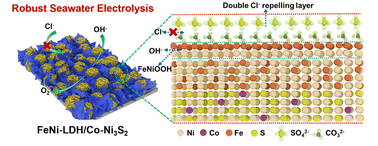
The sustainable production of hydrogen (H2) through water electrolysis is a promising solution for renewable energy storage, yet its scalability is restricted by the scarcity of freshwater resources. Seawater electrolysis offers an alternative, but chloride-induced corrosion and the chlorine evolution reaction hinder its practical use. Here, we report an Fe–Ni layered double hydroxide/Co-doped nickel sulfide (LDH/Co-Ni3S2) hybrid electrocatalyst, engineered with a multi-anion synergistic interface. The electrocatalyst utilizes an interlayer carbonate (CO32−) in the LDH and in situ generated sulfate (SO42−) from Co-Ni3S2 to form a double electric layer shielding effect, preventing Cl− penetration. In situ Raman spectroscopy shows that FeNi-LDH partially converts to iron–nickel oxyhydroxide (FeNiOOH) during operation, which, with strong Lewis acidity, reduces hydroxide adsorption energy. The hybrid structure provides abundant active sites and efficient mass transport, achieving an OER overpotential of 451 mV at 500 mA cm−2 in alkaline seawater. The electrocatalyst demonstrated remarkable stability for 500 h at 500 mA cm−2 in 1 M KOH seawater, while also exhibiting 120 h of durability in 6 M KOH seawater at the same current density. As a bifunctional electrocatalyst, it enables methanol-assisted seawater splitting at 1.68 V for 100 mA cm−2 with near-unity faradaic efficiency, effectively suppressing chloride oxidation. This dual engineering strategy offers new insights into robust seawater-based H2 production.
 Please wait while we load your content...


