


 PLATFORM UPDATE:


In situ growth of graphdiyne on ZnCo-ZIF for enhanced lithium–sulfur battery performance
 *ab
Jia
Peng,
a
*ab
Jia
Peng,
a
Abstract
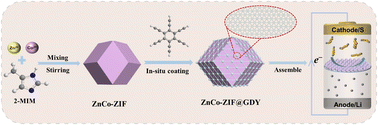
Due to its high theoretical specific capacity and environmental friendliness, the lithium–sulfur (Li–S) battery is regarded as the next generation high energy density storage system. However, the shuttling of polysulfides is one of the major technical problems which hinders its practical application. MOFs (metal–organic frameworks) have been proven to act as separators for energy-storage applications. However, pristine MOFs suffer from poor electrical/ionic conductivity issues and mechanical brittleness that limit the improvement of electrochemical performance. As a new allotrope of carbon, graphdiyne (GDY) can be synthesized on various substrates and has exceptional electrical/ionic conductivity and high mechanical strength, rendering it a perfect supporting or compounded material. In this work, GDY was uniformly and continuously grown in situ on the surface of ZnCo-ZIF (named ZnCo-ZIF@GDY) and applied as a modified membrane separator in Li–S batteries to alleviate the shuttle effect of polysulfides. The uniformly distributed smaller-sized triangular pores in GDY, combined with its enhanced electrical/ionic conductivity, effectively suppress the polysulfide shuttle effect and significantly boost electrochemical performance. As a result, the Li–S battery with the ZnCo-ZIF@GDY/PP (polypropylene) separator showed an initial specific capacity as high as 1126.1 mA h g−1 at 0.2C (1C = 1675 mA g−1) and 680.3 mA h g−1 even at 3C, presenting improved rate performance and cycling stability compared to that of ZnCo-ZIF/PP and PP separators. This research not only presents a straightforward method for preparing GDY-based composites but also offers a perspective on the development and enhancement of MOFs and their derivatives for improved energy storage performance.
 Please wait while we load your content...


