


 PLATFORM UPDATE:


Growth of cylindrical micelles and their use to prepare porous materials with tailored dimensions and alignment

Abstract
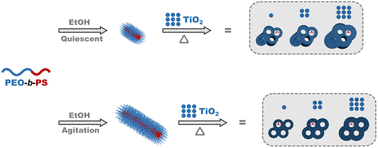
Materials with cylindrical pores are optimal for electrochemical devices and filtration due to their straight paths with minimal tortuosity when aligned. Polymer templates have led to many individual cylindrical architectures however the independent tailoring of pore and wall dimensions has remained elusive. Here short cylindrical micelle templates (PEO-b-PS) with glassy cores enabled the fabrication of sample series with constant cylindrical pore diameter (∼63 nm) and tailored wall thickness (TiO2, ∼45–100 nm). This ShortCyl series (aspect ratio 4.25) had modest alignment that was attributed to the low free-energy cost for misalignment. Though the plasticized micelles (DCM present) were kinetically trapped while quiescent, an agitation based growth process was found to elongate the cylindrical micelles (aspect ratio 15.1) and was consistent with a surface-limited process. After vitrification, a series of LongCyl samples were templated that exhibited enhanced alignment while also enabling independent control of pore and wall dimensions. Geometric models were derived for aligned cylinders (2D PMT model) and non-aligned cylinders (3D PMT model), however orientation order parameters were better able to distinguish the extent of cylinder alignment. These results highlight how innovative micellization and self-assembly methods enable diverse architectures with tailored extent of alignment.
 Please wait while we load your content...


