


 PLATFORM UPDATE:


Elucidating the geometric and electronic structure of a fully sulfided analog of an Anderson polyoxomolybdate cluster

Abstract
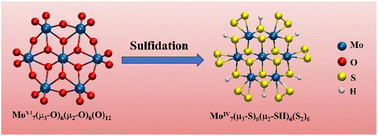
The catalytic activity of transition metal sulfide (TMS) clusters in small molecule activation, redox transformations, and charge transfer has inspired the design of novel TMS-based materials for energy-related catalysis and chemical applications. Polyoxometalates (POMs), known for their structural diversity, can in principle be transformed into TMS clusters; however, fully sulfided analogs are rarely isolated, likely due to the strong tendency of uncapped TMS clusters to agglomerate. Here, we report the geometric and electronic structure of a capping ligand-free fully sulfided analog of heptamolybdate Anderson POM [MoVI7O24]6−, synthesized through the sulfidation of a nanoconfined POM secured within a porous Zr-metal organic framework (NU-1000). A combined computational and experimental analysis indicates that the sulfided counterpart of the Anderson POM is geometrically and electronically more sophisticated than the parent POM. Comparison of experimental pair distribution function (PDF) data with computational simulations confirms that, unlike the oxygen-only [MoVI7O24]6− cluster, the [MoIV7(μ3-S)6(μ2-SH)6(S2)6]2− polythiometalate (PTM) exhibits diverse sulfur anions (S2−, HS−, S22−). DFT calculations indicate that H2S acts as a reducing agent, and together with terminal disulfide (S22−) ligands in the PTM structure, facilitates the complete reduction of all seven MoVI centers in the parent POM to MoIV. These findings are supported by X-ray photoelectron spectroscopy (XPS), which confirms exclusive MoIV, and elemental analysis, which shows quantitative sulfur incorporation. Difference envelope density (DED) mapping further reveals that the PTM clusters are spatially confined within the MOF pores, preventing agglomeration and preserving molecular integrity.
 Please wait while we load your content...


