


 PLATFORM UPDATE:


Anion-modulated bifunctional electrocatalytic activity of nickel telluride/cobalt telluride mesoporous nanosheets for high-efficiency and stable overall water splitting

Abstract
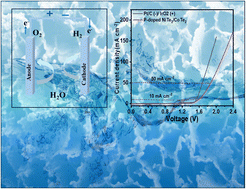
Bimetallic tellurides have recently been employed as promising electrocatalysts for the hydrogen evolution reaction (HER) and oxygen evolution reaction (OER) due to their enhanced electronic conductivity, tunable electronic state, optimized adsorption energy for intermediates, and synergistic interactions between metal centers. However, further improvement in the catalytic performance is necessary to reduce the overpotential and increase the durability. Herein, we synthesized a P-doped NiTe2/CoTe2 mesoporous hierarchical nanosheet array on carbon cloth via a simple hydrothermal process, followed by phosphorization to introduce P doping. The incorporation of phosphorus stabilizes tellurium vacancies, via compensation of the coordination number, which increases the electrocatalytic activity via a modified electronic structure. The P-doped NiTe2/CoTe2 mesoporous nanosheet array demonstrates outstanding performance for the OER, with a low overpotential of 251 mV at a current density of 25 mA cm−2 (η25 = 251 mV), and the HER with an overpotential of 83.53 mV at a current density of 10 mA cm−2 (η10 = 83.53 mV), and overall water splitting requires 1.59 V to reach a current density of 10 mA cm−2. The unprecedented activity could be ascribed to the synergetic effect of the modified electronic structure induced by P doping, NiTe2/CoTe2 heterostructure, and the well-defined mesoporous architecture, which facilitates efficient electrolyte penetration, increases the number of active sites, and enhances mass and charge transport. This work provides valuable insights into the strategic design of electrocatalysts and establishes a foundation for developing telluride-based electrocatalysts using non-noble transition metals.
 Please wait while we load your content...


