


 PLATFORM UPDATE:


Deep-learning-assisted high-throughput discovery of metallophilic MA2Z4 nanomaterials

Abstract
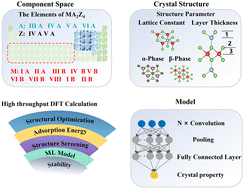
With the growing demand for advanced energy materials, finding suitable metallic electrode nanomaterials with strong metallophilicity remains challenging. Machine learning methods offer powerful tools to tackle this issue by enabling efficient exploration of the extensive compositional space and accurate modeling of complex interactions. We investigated the interactions between seven-layered MA2Z4 nanomaterials and eight metal atoms using computational simulations, a high-throughput workflow and multitask machine learning (MTL) to explore a vast compositional space. We built a comprehensive dataset of 2592 MA2Z4 nanomaterials and identified 2018 stable adsorption structures for training models. Using the MTL and crystal graph convolutional neural network (CGCNN), we achieved superior accuracy in predicting adsorption energy of nanomaterials compared to traditional Auto-ML models. MA2Z4 nanosheets with low-electronegativity A elements and highly-electronegativity Z elements exhibit high stability and metallophilicity, making them promising electrode nanomaterials. This study highlights the power of integrating MTL and CGCNN methodologies to accelerate the discovery and optimization of novel energy nanomaterials.
 Please wait while we load your content...


