


 PLATFORM UPDATE:

DMC matters: the role of dimethyl carbonate in SEI formation on oxygen functionalized anodes†
 *a
Henry A.
Cortés,
a
Mauricio
Rincón Bonilla,
a
Javier
Carrasco
cd
and
Elena
Akhmatskaya
ad
*a
Henry A.
Cortés,
a
Mauricio
Rincón Bonilla,
a
Javier
Carrasco
cd
and
Elena
Akhmatskaya
ad
Abstract
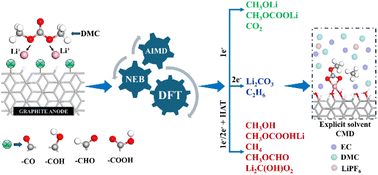
Understanding the decomposition mechanisms of electrolyte components on functionalized graphite anodes is critical for optimizing solid electrolyte interphase (SEI) formation and enhancing Li-ion battery performance. This study employs first principles calculations and reactive force field (ReaxFF) simulations to examine the thermodynamic and kinetic feasibility of dimethyl carbonate (DMC) decomposition on four functionalized graphite surfaces (–CO, –COH, –CHO, and –COOH functional groups) during the early stages of battery operation. Our findings reveal that three distinct Hydrogen Atom Transfer (HAT) mechanisms play a key role in DMC decomposition. Among the studied functional groups, –COH exhibits the highest reactivity, followed by –COOH, enabling multiple favorable decomposition pathways. Besides the well-known SEI organic components such as CH3OLi and CH3OCOOLi, we predict the formation of less-reported species, including CH4, CH3OC(OH)OLi, CH3OCHO, CH3OCH3, LiHCO3, and Li2C(OH)O2. Notably, we identify strong competition between DMC and ethylene carbonate/fluoroethylene carbonate decomposition, particularly on –COH and –COOH surfaces, which should profoundly impact SEI formation and evolution. ReaxFF simulations further reveal that inorganic species like LiHCO3 and Li2C(OH)O2 act as precursors for the formation of Li2CO3, a key inorganic SEI component. Moreover, organic decomposition products are found to detach and diffuse away from –COH, –CHO, and –COOH functionalized surfaces, supporting a bottom-up SEI formation mechanism. Conversely, –CO strongly binds organic species via Li+ ions, potentially leading to surface poisoning over extended battery operation. These insights provide a comprehensive understanding of how functional groups influence DMC decomposition and general SEI evolution, offering valuable guidance for designing more stable and efficient anode materials for Li-ion batteries.
 Please wait while we load your content...


