


 PLATFORM UPDATE:

Semi-interpenetrating polymer network electrolyte membrane for enhanced lithium-ion transport and interfacial stability in silicon-based lithium-ion battery
 a
Dukjoon
Kim
*a
a
Dukjoon
Kim
*a
Abstract
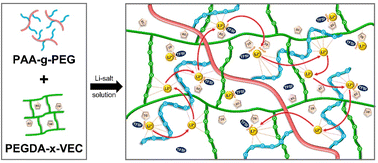
A robust semi-interpenetrating polymer network (SIPN) solid electrolyte with high lithium (Li)-ion transport capability is developed using a poly(acrylic acid)-g-poly(ethylene glycol) (PAA-g-PEG) matrix and a cross-linked network generated from poly(ethylene glycol) diacrylate and vinylene carbonate (PEG-x-VEC). The PAA backbone with carboxylic acid groups enhances the interfacial compatibility with the silicon (Si) surface via strong hydrogen bonds while the flexible PEG graft chains create effective ion pathways via dipole-ion interactions between ether groups and Li-ions. The cross-linked PEG-x-VEC network not only provides the electrolyte membrane with a high mechanical stability, but also single Li-ion transport promoting Li-salt dissociation and free Li-ion transport. The flexible SIPN membrane shows outstanding Li-ion conductivity of 1.61 mS cm−1 and a lithium transference number of 0.64 with a high tensile strength of 1.62 MPa and Young's modulus of 73 MPa at room temperature. The Si/SIPN membrane/LiFePO4 cells deliver an excellent discharge capacity of 142.95 mAh g−1 at 0.5 C, with 80.6% retention capacity, maintaining a coulombic efficiency of 96.9% after 300 cycles.
 Please wait while we load your content...


