


 PLATFORM UPDATE:


Salinity resistance and wind-enhanced evaporation of biomass-derived foam for sustainable solar desalination

Abstract
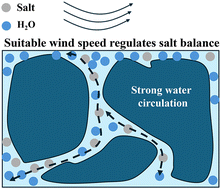
Solar-driven interfacial water evaporation is a promising sustainable desalination strategy, but most research has been predominantly focused on material innovation and evaporation rate enhancement, while little attention has been paid to the impact of convective airflow on salt resistance and energy efficiency. Herein, a novel biomass-derived porous evaporator based on carbonized wild rice root (CWRR) with interconnected microchannels was fabricated. The obtained CWRR-based evaporator exhibited remarkable salt tolerance, with a stable evaporation rate of 1.12 kg m−2 h−1 in 10 wt% NaCl solution over 6 h at efficiencies reaching 82.1%. The addition of convective airflow further enhanced the evaporation performance in 3.5 wt% NaCl at 2 m s−1 wind speed to yield a sustained evaporation rate of 2.19 kg m−2 h−1 over 6 h at efficiencies reaching 94.3%, highlighting remarkable energy utilization. Further analysis of the data revealed that moderate airflows could optimize vapor diffusion while improving salt deposition, and excessive wind velocities could disrupt the evaporation balance state, thereby accumulating salt and declining efficiency. Overall, solar desalination can be optimized by combining environmental airflow control with sustainable biomass materials as a promising novel strategy for future advanced desalination devices.
 Please wait while we load your content...


