


 PLATFORM UPDATE:


Low-capacitance pulsed discharge enables heat- and solvent-free delamination of lithium-ion battery cathodes
 *ab
Moe
Nakahara,
a
Takatoshi
Kurihara,
a
Akiko
Kubota,
a
Mauricio
Córdova-Udaeta,
a
Asako
Narita
a
and
Yutaro
Takaya
b
*ab
Moe
Nakahara,
a
Takatoshi
Kurihara,
a
Akiko
Kubota,
a
Mauricio
Córdova-Udaeta,
a
Asako
Narita
a
and
Yutaro
Takaya
b
Abstract
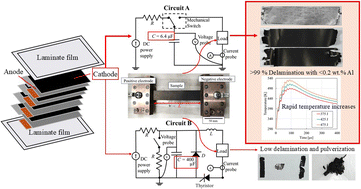
Recovering cathode-active materials (CAMs) from end-of-life lithium-ion batteries without added heat or chemicals is pivotal for low-impact, closed-loop manufacturing. We show that circuit capacitance dictates whether a single electrical pulse yields clean, solvent-free delamination or destructive pulverization. Commercial Li(Ni0.33Mn0.33Co0.33)O2 coated on aluminum foil was exposed to 375–475 J discharges from 6.4 μF (low-C) and 400 μF (high-C) capacitor banks. The low-C circuit squeezed the stored energy into sub-200 μs current spikes (≈15 kA) that heated the CAM/Al interface from ambient to ≈500 K within 100 μs, generating transient stresses of tens of MPa before the foil was severed. A 425 J pulse cleanly lifted the entire coating (99.9 wt% CAMs), leaving only 0.3 wt% residual aluminum, and X-ray diffraction confirmed that the layered oxide structure remained intact. Conversely, the high-C circuit stretched the same energy over > 500 μs, diverting the current into the plasma and fragmenting both the foil and coating. The delamination plateaued near 90 wt%, and at 475 J, aluminum contamination surged nine-fold. One-dimensional transient heat-rise analysis corroborated that temporal energy concentration—enabled by low capacitance—triggers the instantaneous interfacial heating required for clean separation, whereas energy dispersion channels power into fragmentation. This heat- and solvent-free pre-treatment supplies battery-grade layered oxides ready for direct cathode recycling, eliminating the furnaces, acids, and wastewater typical of pyro- or hydrometallurgical routes.
 Please wait while we load your content...


