


 PLATFORM UPDATE:


Microscopic structural study on the growth history of granular heaps prepared by the raining method
 c
Yujie
Wang
*abc
c
Yujie
Wang
*abc
Abstract
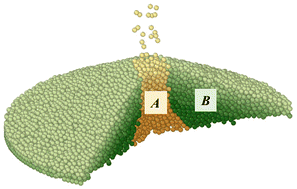
Granular heaps are critical in both industrial applications and natural processes, exhibiting complex behaviors that have attracted significant research attention. The stress dip phenomenon observed beneath granular heaps continues to be a topic of significant debate. Current models based on force transmission often assume that the packing is near the isostatic point, overlooking the critical influence of the internal structure and formation history on the mechanical properties of granular heaps. Consequently, these models cannot fully capture for diverse observations. In this study, we experimentally explore the structural evolution of three-dimensional (3D) granular heaps composed of monodisperse spherical particles prepared using the raining method. Our results reveal a continuous transition from a densely packed central core to more loosely packed outer regions, characterized by significant differences in structural properties such as contact number and contact anisotropy. We attribute these structural variations to the differing formation mechanisms during heap growth. Our findings emphasize the substantial influence of the preparation protocols on the internal structure of granular heaps and provide valuable insights into stress distribution within granular materials. This research may contribute to the development of more accurate constitutive relations for granular materials.
 Please wait while we load your content...


