


 PLATFORM UPDATE:


Integration of solar passive heating strategies in low-cost biogas plants

Abstract
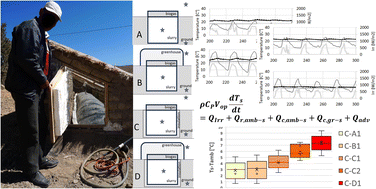
This study analyzes the influence of various solar passive heating designs on the thermal performance of low-cost tubular digesters in cold climate regions through experimental and simulation tools. Five full-scale low-cost tubular digesters were monitored in the Andean region: one with both greenhouse and trench insulation, two with trench insulation only (thicknesses of 1 cm and 5 cm), one with a greenhouse only, and control (without any solar passive heating design). The most effective solar passive strategy was found to be the combination of greenhouse and insulation, achieving a slurry temperature increase of +7.4 °C above the ambient temperature. The trench insulation enhanced the slurry temperature, with temperature increases ranging from +4.3 °C to +6 °C, depending on the insulation thickness. Conversely, greenhouses alone showed minimal thermal benefit (+0.8 °C). A unique simplified dynamic thermal model was developed to simulate the thermal performance of these digesters, achieving a root mean square error below 1 °C across all configurations. These findings demonstrate that solar passive heating designs can substantially improve the efficiency of anaerobic digestion in cold climates, promoting sustainable biogas production.
 Please wait while we load your content...


