


 PLATFORM UPDATE:


Artificial intelligence (Al) in healthcare diagnosis: evidence-based recent advances and clinical implications

Abstract
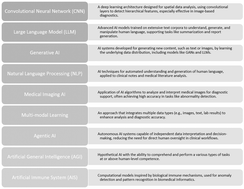
Artificial intelligence (AI) is increasingly shaping modern healthcare by improving the accuracy and efficiency of disease diagnosis. This review summarises the modern advancements in AI-driven diagnostic technologies, with a focus on machine learning (ML) and deep learning (DL) applications for the detection and characterization of cancer, cardiovascular diseases, diabetes, neurodegenerative disorders, and bone diseases. AI models, particularly those employing convolutional neural networks, have demonstrated expert-level performances in interpreting medical images, genomic profiles, and electronic health records, often surpassing traditional diagnostic methods in terms of sensitivity, specificity, and overall accuracy. Using advanced methods like machine learning and deep learning, AI systems can analyze large and complex medical datasets—including images, electronic health records, and laboratory results—to detect patterns linked to various diseases. While integration of AI into clinical practice has shown significant benefits, challenges remain in ensuring the reliability, interpretability, and broad adoption of these systems. Thus, continued research and careful implementation are needed to maximize the potential of AI in transforming diagnostic processes and improving patient outcomes.
 Please wait while we load your content...


