


 PLATFORM UPDATE:


Organic–inorganic perovskite ferroelectric catalytic selective alkyne coupling under ultrasound sonication

Abstract
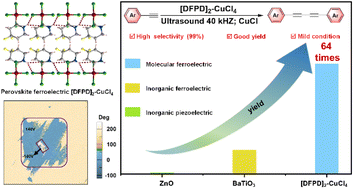
Alkyne coupling represents a significant reaction in organic synthesis, while conventional methods rely on high-cost catalysts and harsh reaction conditions. Although ferroelectrics with spontaneous polarization facilitating charge separation have recently attracted great attention as emerging catalysts, their catalytic potential in alkyne coupling remains unexplored. Herein, we report a new organic–inorganic perovskite ferroelectric [4,4-difluoropiperidinium]2-CuCl4 ([DFPD]2-CuCl4), which exhibits a high phase transition temperature of 398 K and room-temperature ferroelectricity. Significantly, by ultrasonic sonication under ambient conditions, and by using [DFPD]2-CuCl4 and additive CuCl as the catalysts, a variety of terminal alkynes can selectively form 1,3-diynes with high yields, with the selectivity and yield up to 99% and 85%, respectively. The high yields enable the growth of crystals of products, three of which exhibit phase transitions. Compared with its inorganic ferroelectric and piezoelectric counterparts, the molecular ferroelectric [DFPD]2-CuCl4 shows significantly enhanced catalytic activity, being approximately 4.5 times that of BaTiO3 and 64 times that of ZnO. Moreover, the [DFPD]2-CuCl4 catalyst demonstrates robust recyclability, with its crystal phase and catalytic activity remaining unchanged over 10 cycles. Our findings provide an efficient and sustainable catalyst system for alkyne coupling and a new perspective on the exploration of ferroelectric catalysis.
 Please wait while we load your content...


