


 PLATFORM UPDATE:


Precision pore engineering via fit-topology assembly in a Zn-porphyrin MOF for selective C2H2 capture
 *a
*a
Abstract
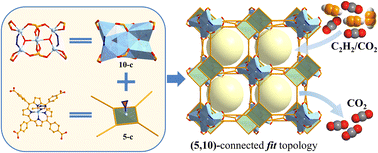
The topology-guided design of porphyrin-based metal–organic frameworks (PMOFs) with tailored ultramicroporosity (<7 Å) remains a formidable challenge, as conventional strategies often fail to balance structural rigidity with precise pore confinement. To address this limitation, we propose a dual-ligand coordination approach, integrating Zn2+-porphyrin chelation and triazole-mediated SBU assembly, to construct Zn-TCPP-dmtrz—a novel PMOF featuring a unique fit topology for C2H2/CO2 separation. Unlike traditional PMOFs with oversized pores (e.g., Al/Y-TCPP), this strategy exploits the synergistic coordination of tetrakis(4-carboxyphenyl)porphyrin (TCPP) and 3,5-dimethyl-1,2,4-triazole (dmtrz) to compress pore apertures to 6.3 × 6.8 Å, closely matching the molecular dimensions of the C2H2 molecule. The resulting ultramicroporous channels, reinforced by staggered porphyrin planes and hydrophobic methyl groups, exhibit high C2H2 uptake (4.30 mmol g−1) and a separation potential (ΔQ = 1.62 mmol g−1) under ambient conditions, outperforming existing PMOFs. Crucially, the framework retains structural integrity under high humidity (90% RH) and cyclic adsorption–desorption, with a low regeneration energy barrier (Qst = 28.5 kJ mol−1). Computational studies attribute the selectivity to confinement-enhanced van der Waals interactions and electrostatic alignment at the porphyrin-Zn interface and methyl-decorated channels. This work establishes a topology-driven pore engineering strategy for PMOFs, advancing the design of next-generation adsorbents for challenging gas separations.
 Please wait while we load your content...


