


 PLATFORM UPDATE:


Activating TiO2 for visible light photocatalysis: a calcination approach to diesel photo-desulfurization under visible light
 *a
and
*a
and
Abstract
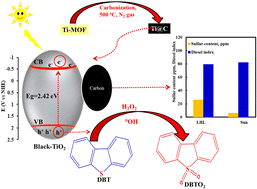
The increasing demand for clean fuels, coupled with stringent sulfur emission regulations, has driven the need for efficient and sustainable desulfurization technologies. In this study, a visible-light-active Black-TiO2 by carbonization of Ti-MOF under vacuum was developed and evaluated for the photocatalytic desulfurization for sulfur-containing pollutant in diesel fuel that poses significant environmental risks. The White-TiO2, Black-TiO2, and Ti-MOF were synthesized through a simple method and comprehensively characterized using XRD, FT-IR, Raman spectroscopy, BET surface area analysis, SEM-mapping, UV-vis diffuse reflectance spectroscopy, and photoluminescence measurements. The Black-TiO2 (Ti@C) demonstrated superior photocatalytic performance compared to individual W-TiO2 or Ti-MOF catalysts, attributed to improved charge separation, reduced band gap, and strong interfacial interactions between Ti and C under visible light. Key operational parameters, including catalyst dosage, H2O2 concentration, and irradiation time, significantly influenced the degradation efficiency. Remarkable degradation efficiencies of 97.99% for real diesel feedstock (1300 ppm sulfur) for LHL, 99.53% under sunlight were achieved, with acetonitrile extraction effectively removing the oxidized sulfur compounds. The catalyst maintained excellent stability and reusability over six consecutive cycles, demonstrating its potential for practical fuel desulfurization applications. This research presents an environmentally friendly, a highly cost-effective, and energy-efficient approach to producing ultra-low sulfur fuels using solar energy.
 Please wait while we load your content...


