


 PLATFORM UPDATE:

Gd3+ engineered Co–Mn–Mg spinel nanoferrites for multifunctional theranostics: magnetic hyperthermia, antioxidant hepatoprotection, and antibacterial activity

Abstract
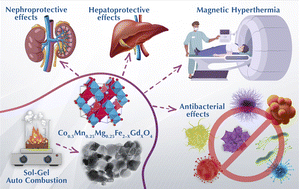
We synthesized Co0.5Mn0.25Mg0.25Fe2−xGdxO4 (x = 0.00; 0.04; 0.06) nanoferrites using a sol–gel auto-combustion method and studied their structural, magnetic, and biological properties. XRD with Rietveld refinement confirmed the formation of a pure spinel structure with nanosized crystallites. FTIR and XPS analyses proved the presence of metal–oxygen bonds, mixed oxidation states of Fe and Co, and the successful incorporation of Gd3+. TEM images revealed nanometric particles with homogeneous elemental distribution. Magnetic measurements showed that Gd3+ doping modifies the saturation magnetization (Ms) and coercivity (Hc), with the best performance at x = 0.04 (Ms = 45.7 emu g−1, Hc = 427 Oe). Under an alternating magnetic field, the samples efficiently produced heat in the hyperthermia range, with a specific absorption rate (SAR) of about 34 W g−1 for x = 0.04. In vivo experiments in ethanol-induced liver injury models demonstrated that the x = 0.04 sample improved antioxidant activity (increased SOD and CAT levels) and restored important serum biochemical markers such as albumin, total protein, creatinine, urea, uric acid, and electrolytes. This indicates strong hepatoprotective and nephroprotective effects. Antibacterial studies further showed that the nanoferrites were more effective against Gram-positive bacteria (S. aureus, B. subtilis, B. licheniformis) than Gram-negative ones (E. coli, P. aeruginosa). Overall, our results show that Gd3+ substitution enhances both magnetic and biological properties. The x = 0.04 composition provides the best compromise between magnetic heating efficiency, antioxidant protection, and antibacterial activity, making these nanoferrites promising candidates for biomedical applications such as cancer hyperthermia therapy, antioxidant defense, and infection control.
 Please wait while we load your content...


