


 PLATFORM UPDATE:

Deciphering the donor–acceptor order: impact of acceptor positioning on the optical properties of anthraquinone-carbazole-cyanostilbenes

Abstract
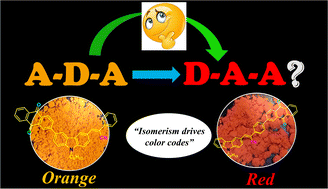
We report a systematic investigation of anthraquinone–carbazole–cyanostilbene conjugates arranged in two distinct connectivity patterns: AQCZCS and CZCSAQ. Despite having identical donor and acceptor units, subtle differences in donor–acceptor ordering profoundly impact their optical and excited-state properties. Both isomers exhibit broad, structureless emission characteristic of charge-transfer (CT) states, with maxima at 635 nm (AQCZCS) and 700 nm (CZCSAQ), corresponding to a pronounced bathochromic shift (Δλ ∼65 nm). Solution-phase emission reflects connectivity-dependent shifts, confirming strong donor–acceptor communication. In the solid state, AQCZCS emits vivid orangish red (610 nm) that shifts to deep red (645 nm) upon mechanical stimulation, while CZCSAQ shows red emission that further bathochromically responds under force, highlighting the tunable mechanochromic behavior. Quantum yields of 2.7% (AQCZCS) and 1.8% (CZCSAQ) demonstrate the effect of topology on emissive efficiency. These findings establish robust structure–property correlations and provide design principles for multifunctional solid-state emitters with highly tunable CT-driven emission across the visible spectrum.
 Please wait while we load your content...


