Issue 53, 2025, Issue in Progress

A covalent organic framework/reduced graphene oxide composites-based electrochemical sensing platform for the detection of enrofloxacin

Abstract

The accurate, sensitive, and efficient detection of enrofloxacin (ENR) residues is critically important for protecting public health and ensuring environmental safety. Herein, a novel electrochemical sensing platform based on a TAPB–PDA covalent organic framework integrated with reduced graphene oxide (TAPB–PDA-COFs/RGO) for the sensitive and selective detection of ENR in aqueous environments was developed. The TAPB–PDA-COFs/RGO leverages the high surface area and ordered pore structure of COFs alongside the excellent electrical conductivity of RGO, resulting in enhanced electrochemical performance. Under optimized conditions, the sensor exhibited a wide linear detection range (0.01–150 µmol L−1), a low detection limit (0.028 µmol L−1), and high selectivity even in the presence of structurally similar fluoroquinolones. The sensor also demonstrated good stability and reproducibility. When applied to spiked tap water samples, the platform achieved satisfactory recoveries of 84.1–99.7% and outperformed the conventional HPLC method at low ENR concentrations. These results highlighted the potential of the TAPB–PDA-COFs/RGO composite as a promising tool for environmental monitoring of antibiotic residues.
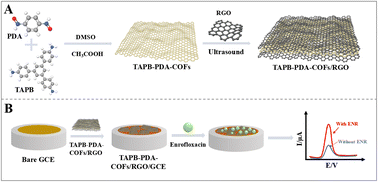
Graphical abstract: A covalent organic framework/reduced graphene oxide composites-based electrochemical sensing platform for the detection of enrofloxacin

Supplementary files

Article information

Article type
Paper
Submitted
10 Oct 2025
Accepted
11 Nov 2025
First published
19 Nov 2025
This article is Open Access
Creative Commons BY-NC license

RSC Adv., 2025,15, 45333-45343

A covalent organic framework/reduced graphene oxide composites-based electrochemical sensing platform for the detection of enrofloxacin

P. Wu, J. Liu, S. Lu, A. zhang, Y. Tian, J. Xiang, S. Wang and P. Ding, RSC Adv., 2025, 15, 45333 DOI: 10.1039/D5RA07733H

This article is licensed under a Creative Commons Attribution-NonCommercial 3.0 Unported Licence. You can use material from this article in other publications, without requesting further permission from the RSC, provided that the correct acknowledgement is given and it is not used for commercial purposes.

To request permission to reproduce material from this article in a commercial publication, please go to the Copyright Clearance Center request page.

If you are an author contributing to an RSC publication, you do not need to request permission provided correct acknowledgement is given.

If you are the author of this article, you do not need to request permission to reproduce figures and diagrams provided correct acknowledgement is given. If you want to reproduce the whole article in a third-party commercial publication (excluding your thesis/dissertation for which permission is not required) please go to the Copyright Clearance Center request page.

Read more about how to correctly acknowledge RSC content.

Social activity

Spotlight

Advertisements