Issue 49, 2025, Issue in Progress

A highly accurate and selective non-enzymatic glucose sensor based on a Fe2O3/CuFe2O4/graphene nanoplatelet nanocomposite

Abstract

In this study, a sensitive and accurate non-enzymatic glucose sensor based on a Fe2O3/CuFe2O4/graphene nanoplatelet (GNPs) nanocomposite was performed. The nanocomposite was synthesized via a facile hydrothermal method and characterized using FTIR, XRD, SEM, Raman, XPS, cyclic voltammetry (CV) and electrochemical impedance spectroscopy techniques. The integration of Fe2O3 and CuFe2O4 with graphene nanoplatelets (GNPs) provides a synergistic effect, enhanced surface area, high electrochemical conductivity and improved catalytic activity toward glucose oxidation. Electrochemical measurements using CV and chronoamperometry demonstrated excellent sensing performance, with high sensitivity of 62.4 μA mM−1 cm−2, a lower of detection limit of 0.049 μM (S/N = 3) and a widely linear detection range from 5–75 μM and 75–13 000 μM. The sensor exhibited outstanding selectivity against common interfering species (e.g., dopamine, uric acid and ascorbic acid), along with good stability and reproducibility. These findings suggest that the Fe2O3/CuFe2O4/GNPs nanocomposite is a promising applicant for glucose non-enzymatic sensing in clinical and biomedical applications.
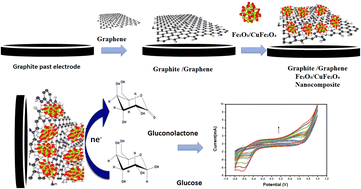
Graphical abstract: A highly accurate and selective non-enzymatic glucose sensor based on a Fe2O3/CuFe2O4/graphene nanoplatelet nanocomposite

Article information

Article type
Paper
Submitted
07 Oct 2025
Accepted
21 Oct 2025
First published
29 Oct 2025
This article is Open Access
Creative Commons BY-NC license

RSC Adv., 2025,15, 41546-41567

A highly accurate and selective non-enzymatic glucose sensor based on a Fe2O3/CuFe2O4/graphene nanoplatelet nanocomposite

L. Bourouba, E. Zouaoui, M. Benounis, H. S. Magar and A. Boumaza, RSC Adv., 2025, 15, 41546 DOI: 10.1039/D5RA07666H

This article is licensed under a Creative Commons Attribution-NonCommercial 3.0 Unported Licence. You can use material from this article in other publications, without requesting further permission from the RSC, provided that the correct acknowledgement is given and it is not used for commercial purposes.

To request permission to reproduce material from this article in a commercial publication, please go to the Copyright Clearance Center request page.

If you are an author contributing to an RSC publication, you do not need to request permission provided correct acknowledgement is given.

If you are the author of this article, you do not need to request permission to reproduce figures and diagrams provided correct acknowledgement is given. If you want to reproduce the whole article in a third-party commercial publication (excluding your thesis/dissertation for which permission is not required) please go to the Copyright Clearance Center request page.

Read more about how to correctly acknowledge RSC content.

Social activity

Spotlight

Advertisements