


 PLATFORM UPDATE:


Sustainable nitrogen-doped carbon dots from biomass for ultrasensitive and selective fluorescent detection of isoliquiritigenin

Abstract
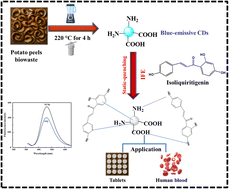
Monitoring isoliquiritigenin (ISQ) is critical given its dual profile of therapeutic promise and dose-dependent toxicity, where precise quantification underpins safe administration, efficacy evaluation, and pharmaceutical quality control. In this study, we introduce a cost-effective and energy-efficient hydrothermal route for synthesizing nitrogen-doped carbon dots (NCDs) from potato peel biowaste, providing a sustainable pathway for agricultural waste valorization. The resulting NCDs exhibited bright green fluorescence with notable photostability and a quantum yield of 44.76%, enabling sensitive ISQ detection via a combined static-quenching and inner filter effect (IFE) mechanism, with a detection limit as low as 2.9 nM. The probe showed good selectivity in the presence of common interferents and satisfactory recovery values in spiked pharmaceutical and serum samples, meeting ICH M10 criteria for analytical performance. While these findings underscore the potential of biomass-derived NCDs as eco-friendly sensing platforms, key challenges must be addressed before clinical or point-of-care translation. These include comprehensive cytotoxicity evaluation, long-term colloidal stability in complex matrices, nanoparticle fate and clearance studies, and standardization of biomass inputs. Future studies should also explore scalable synthesis protocols, regulatory compliance pathways, and compatibility with miniaturized or wearable diagnostic devices. This work offers a promising step toward green nanotechnology for biomedical monitoring, while recognizing the critical hurdles that must be overcome for real-world implementation.
 Please wait while we load your content...


