


 PLATFORM UPDATE:


Riboflavin-sensitized photoinduced degradation of donepezil hydrochloride: kinetic and computational insights for pharmaceutical formulation

Abstract
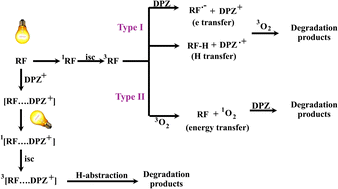
Donepezil (DPZ) photosensitized degradation by riboflavin (RF) at pH 2.0–12.0 has been carried out in aerobic and anaerobic conditions under UV and visible irradiation to give an idea to pharmaceutical formulators to develop a stable co-formulation to administer to elderly patients with neurodegenerative diseases (Alzheimer's disease, Parkinson's disease). The photolysis rate constants (kobs) in aerobic and anaerobic conditions in the presence of RF (0.1–0.5 × 10⁻⁴ M) range from 0.25–11.5 and 0.025–1.120 × 10⁻² min−1, respectively. RF catalyzes the photodegradation of DPZ, and the second-order (k2) constants in aerobic and anaerobic conditions range from 0.32 to 8.22 and 0.032 to 0.805 × 10⁻² M−1 min−1, respectively, indicating that with an increase in the concentrations of RF, the rate of photolysis of DPZ also increases. The k-pH profile shows a bell-shaped curve from pH 2.0 to 4.0 and from pH 5.0 to 12.0, forming a sigmoid curve. The two-component spectrometric and HPLC green methods have been developed and validated for estimating DPZ and RF in pure and degraded solutions. Additionally, computational studies have been conducted to assess the formation of the ground-state complex, binding affinity, and molecular interactions between DPZ and RF.
 Please wait while we load your content...


