


 PLATFORM UPDATE:

Reduced temperature solid-state synthesis of barium sulfide: a greener alternative

Abstract
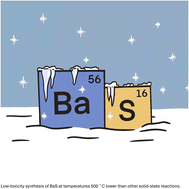
Barium sulfide (BaS) serves as a commonly used precursor for advanced barium-based materials, including the emerging perovskite photovoltaic absorber BaZrS3. However, conventional BaS production methods are highly energy-intensive, requiring temperatures well exceeding 1000 °C and emitting large quantities of CO2 and SO2, and raising valid environmental concerns. This work presents a novel solid-state synthesis route for BaS that drastically reduces the environmental and energy demands. By employing a finely milled mixture of barium hydroxide [Ba(OH)2] and elemental sulfur, we achieve an efficient conversion (90%) to BaS at a remarkably low annealing temperature of 500 °C. The process is enabled by a low-pressure annealing environment, which facilitates the rapid vaporisation of H2O byproducts while maintaining a controlled sulfur partial pressure. This prevents unwanted side reactions and enhances conversion efficiency by continuously removing waste gases, including water vapour and trace amounts of SO2, while preserving optimal reaction conditions. The success of the process was confirmed through X-ray diffraction, and aided by Fourier transform infrared spectroscopy, and Raman spectroscopy. The extent of conversion was quantitatively determined using Rietveld refinement of the diffraction patterns. This method offers a more sustainable and economically viable pathway for BaS production. Residual gas analysis has shown a significant reduction in CO2 and SO2 production compared to earlier processes.
 Please wait while we load your content...


