


 PLATFORM UPDATE:


Pb9Cu(PO4)6O: a room-temperature superconductor? electronic-structure features assessed via the flat/steep band model
 *ac
Shuiquan
Deng
*ac
*ac
Shuiquan
Deng
*ac
Abstract
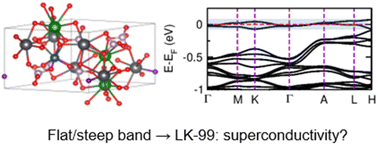
The recent claim of room-temperature superconductivity in copper-doped lead apatite Pb10−xCux(PO4)6O (0.9 < x <1.1) (LK-99) has stimulated widespread research, yet experimental validations consistently attribute its resistivity drops to impurities and find no evidence of zero resistivity and Meissner effect. To clarify the electronic properties of this system, we conduct systematic first-principles calculations incorporating multi-Cu doping configurations of Pb9Cu(PO4)6O beyond previously studied single substitutions. Our results demonstrate that while certain single-Cu models exhibit metallicity, all proposed structures, including double-Cu-doped supercells and c-axis chain models, display extremely narrow bandwidths (≤0.25 eV) and a lack of steep dispersive bands near the Fermi level. These features, incompatible with the flat/steep band model of superconductivity, along with the absence of characteristic electronic structures found in known superconductors, strongly suggest that LK-99 derivatives are not superconducting.
 Please wait while we load your content...


