


 PLATFORM UPDATE:


A review of metal ion complexation/decomplexation reaction-based fluorescent sensors for detecting biological thiols

Abstract
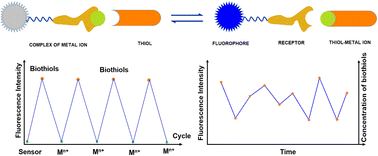
Biothiols such as glutathione (GSH), cysteine (Cys), and homocysteine (Hcy) are essential to many physiological and biochemical processes in humans, and their abnormal levels are associated with various health disorders. Fluorescent sensors based on metal ion complexation/decomplexation have emerged as powerful tools for the selective and sensitive detection of these thiols. This review highlights recent advances in biothiol sensing systems mediated by metal ions. Complexes of Cu2+ and Hg2+ have been most extensively investigated, while only limited studies involve ions such as Fe3+ and Ag+. The discussion emphasizes sensor mechanisms elucidated through analyses of reaction pathways, coordination chemistry, redox properties, stability constants, together with investigations of biothiol speciation at different pH values and their reactions with metal ions. Additional considerations include detection limits, selectivity, reusability, and applications. Although the structural similarity of GSH, Cys, and Hcy makes their discrimination challenging, several sensors exploit steric or redox differences to achieve selectivity. These insights clarify current challenges and highlight future directions for rational sensor design.
- This article is part of the themed collection: 2025 Reviews in RSC Advances
 Please wait while we load your content...


