


 PLATFORM UPDATE:


Sensitive superoxide dismutase detection via luminol–oxygen electrochemiluminescence enhanced by zero-dimensional carbon catalysts in mesoporous nanochannels
 *b
and
*b
and
Abstract
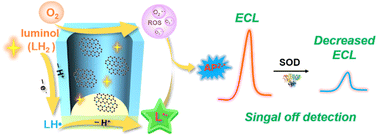
The detection of superoxide dismutase (SOD) is crucial for monitoring the antioxidant defense system. In this study, an electrochemical-assisted self-assembly (EASA) method was used to in situ grow amino-functionalized vertically ordered mesoporous silica film (NH2-VMSF) on an ITO electrode, creating highly ordered nanochannel structures. Nitrogen-doped graphene quantum dots (NGQDs) were then confined within these channels via electrophoretic deposition, resulting in a composite electrode, NGQDs@NH2-VMSF/ITO. The introduction of NGQDs significantly enhanced the electrode's catalytic activity for the oxygen reduction reaction (ORR), facilitating the generation of superoxide anion radicals (O2˙−) and promoting the electrochemical oxidation of luminol, which substantially increased the electrochemiluminescence (ECL) signal of the luminol–dissolved oxygen (DO) system. In the presence of SOD, O2˙− is selectively eliminated by SOD, leading to a decrease in the ECL signal as the SOD concentration increases. This “signal-off” response enables highly sensitive detection of SOD. The developed ECL sensor demonstrated a linear relationship within the SOD concentration range of 0.005–5 µg mL−1, with a limit of detection (LOD) as low as 0.87 ng mL−1 (S/N = 3). This work offers a reliable sensing platform for analyzing antioxidant activity and related disease biomarkers.
 Please wait while we load your content...


