


 PLATFORM UPDATE:


Numerical optimization of Rb2AuScBr6 and Rb2AuScCl6-based lead-free perovskite solar cells: device engineering and performance mapping

Abstract
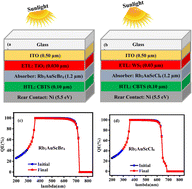
Perovskite solar cells (PSCs) exhibit significant potential for next-generation photovoltaic technology, integrating high power conversion efficiency (PCE), cost-effectiveness, and tunable optoelectronic properties. This report presents a comprehensive numerical optimization of Rb2AuScBr6 and Rb2AuScCl6-based PSCs, with particular emphasis on the influence of electron transport layers (ETLs) and critical device parameters. The configuration ITO/TiO2/Rb2AuScBr6/CBTS/Ni achieves a PCE of 27.49%, whereas the configuration ITO/WS2/Rb2AuScCl6/CBTS/Ni attains 22.41%, thereby underscoring the high efficiency of these lead-free materials. Device performance is markedly improved through increased perovskite layer thickness and reduced defect density. Further stabilization of performance is achieved by optimizing electron affinity, series resistance, and shunt resistance. Additionally, thermal stability is enhanced through the adjustment of operational temperature. The superior PCE observed in Rb2AuScBr6 is ascribed to the selection of the ETL, an optimal band gap, absorber layer thickness, lower defect density, and appropriate contact interfaces. Overall, these Rb2AuScBr6 and Rb2AuScCl6 perovskites demonstrate exceptional promise for practical, efficient, and stable PSC applications, thereby encouraging further experimental validation and device engineering.
 Please wait while we load your content...


