


 PLATFORM UPDATE:


Urea-functionalized HKUST-1 metal–organic framework for high-performance lead adsorption

Abstract
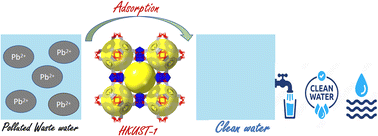
Heavy metal contamination, particularly from lead (Pb2+), poses serious environmental and health risks, thereby driving the need for advanced remediation strategies. In this study, both pristine HKUST-1 and urea-functionalized HKUST-1 (HKUST-1@Urea) were synthesized and systematically compared for Pb2+ removal from aqueous solutions. Structural and spectroscopic analyses (XRD, FT-IR, and SEM) confirmed successful urea incorporation, which introduced amino and carbonyl groups that both improve hydrophilicity and increase the density of adsorption sites. Adsorption experiments demonstrated that HKUST-1@Urea outperformed unmodified HKUST-1, achieving 98% Pb2+ removal within 45 min and a maximum adsorption capacity of 400 mg g−1, compared to the lower values of HKUST-1. Isotherm modeling indicated favorable monolayer adsorption, while kinetic fitting revealed fast surface interactions described by a pseudo-second-order model. Thermodynamic evaluation further confirmed that the adsorption mechanism was spontaneous (ΔG° = −4.29 to −7.95 kJ mol−1), endothermic (ΔH° = +29.48 kJ mol−1), primarily physisorption-driven (ΔH° < 40 kJ mol−1), and accompanied by increased interfacial disorder (ΔS° = +0.118 kJ mol−1 K−1). Notably, HKUST-1@Urea maintained over 90% removal efficiency across multiple cycles, highlighting its excellent stability and reusability. These results establish HKUST-1@Urea as a cost-effective and sustainable adsorbent with strong potential for practical water purification, demonstrating the advantages of post-synthetic urea modification for enhancing MOF performance.
 Please wait while we load your content...


