


 PLATFORM UPDATE:


Optoelectronic properties and device simulation of ZnS polymorphs as buffer layers for CZTSSe solar cells

Abstract
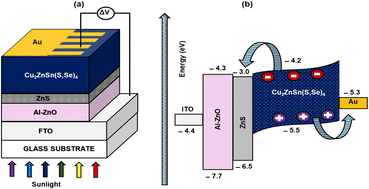
Kesterite (CZTSSe) has emerged as a sustainable thin-film absorber, yet its device efficiencies remain below those of leading photovoltaic technologies. Optimizing the buffer layer (BL) is a promising strategy to overcome these limitations. Here, we combined density functional theory (DFT) calculations with SCAPS-1D simulations to systematically evaluate ZnS polymorphs (cubic, hexagonal, trigonal) as a BL for CZTSSe solar cells. DFT analysis (GGA-PBE, CASTEP) reveals band gaps of 3.51 eV (cubic), 3.52 eV (hexagonal), and 3.53 eV (trigonal). The hexagonal phase exhibits superior carrier transport properties with electron and hole mobilities of 343.2 and 92.6 cm2 V−1 s−1, respectively. Density-of-states analysis confirms Zn-3d orbitals lie deep in the valence band, with S-3p levels predominating close to the Fermi level, and Zn-4s/4p defining the conduction band, highlighting S-3p → Zn-4s/4p transitions. SCAPS-1D simulations for the device ITO/AZO/ZnS/CZTSSe/Au demonstrate that the crystal phase of ZnS strongly impacts photovoltaic performance. Utilizing hexagonal ZnS BL achieves the highest efficiency (PCE 14.18%, JSC 25.93 mA cm−2, FF 62.5%) due to the higher mobility of that crystal system. Furthermore, systematic variation of ZnS thickness, donor density, mobility, band gap, and bulk/interface defect densities, along with back-contact work function and operating temperature, reveals critical design parameters governing charge recombination, series resistance, and interfacial quality to improve performance. This combined theoretical-simulation study highlights that hexagonal ZnS emerges as the most effective BL for CZTSSe solar cells, offering superior carrier transport and interfacial stability for enhanced device efficiency.
 Please wait while we load your content...


