


 PLATFORM UPDATE:


Fabrication and evaluation of PLA/CPP/GO composite scaffolds: the role of graphene oxide content in regulating properties
 *a
Yuying
Zheng
*c
*a
Yuying
Zheng
*c
Abstract
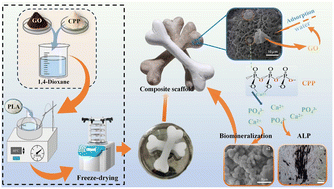
The development of bone tissue engineering scaffolds that combine biomimetic architecture with osteoinductive properties remains a challenge. In this study, a series of poly(lactic acid)/calcium polyphosphate/graphene oxide (PLA/CPP/GO) composite scaffolds with varying GO contents were fabricated via phase separation. The influence of GO concentration on the scaffold properties was systematically investigated. Results indicated that the incorporation of GO markedly enhanced the microstructure, hydrophilicity, and bioactivity of the scaffolds. Specifically, at GO loadings of 0.5–1.5 wt%, the scaffolds developed a refined fibrous architecture with highly interconnected pores (porosity > 90%), and demonstrated optimal mechanical strength (compressive strength ∼2.34 MPa) and improved wettability. More significantly, GO effectively augmented the biomineralization capacity and osteogenic potential of the scaffolds. In vitro biomineralization assays revealed that GO facilitated the deposition of carbonate hydroxyapatite. Cell culture studies further showed that scaffolds with 0.5 wt% GO significantly enhanced alkaline phosphatase (ALP) activity in MC3T3-E1 cells, indicating promoted osteogenic differentiation. This study demonstrates that an appropriate amount of GO can endow PLA/CPP-based scaffolds with favorable mechanical properties, high porosity, excellent bioactivity, and osteoinductivity, making them promising candidates for bone tissue engineering applications.
 Please wait while we load your content...


