


 PLATFORM UPDATE:


High-efficiency encapsulation and pH-triggered release of docetaxel from folic acid-functionalized ZIF-90 nanocarriers
 *bc
and
Azad H.
Alshatteri
*d
*bc
and
Azad H.
Alshatteri
*d
Abstract
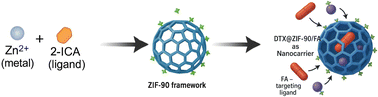
Metal–organic frameworks (MOFs) offer promising features for drug delivery owing to their high porosity, tunable structures, and surface functionality. Among them, zeolitic imidazolate framework-90 (ZIF-90) is notable for its aldehyde groups, which enable facile functionalization and enhanced biocompatibility. In this work, we report folic acid-modified ZIF-90 nanoparticles as pH-responsive carriers for docetaxel (DTX), a widely used chemotherapeutic agent for breast cancer. The nanocarriers displayed a uniform nanoscale morphology and achieved a high encapsulation efficiency of 92.8% with a drug loading capacity of 8.43%. In vitro release studies revealed pronounced pH sensitivity, with accelerated drug release under acidic conditions (pH 5.5), mimicking tumor and endosomal environments, while release was sustained at the physiological pH of 7.4. Kinetic modelling indicated that the Hixson–Crowell and Korsmeyer–Peppas models best described the release, suggesting a combination of surface erosion and anomalous diffusion. Compared with the more widely studied ZIF-8 systems, ZIF-90 offered distinct advantages in enabling stable folic-acid conjugation and enhanced acid-labile degradation. The incorporation of folic acid conferred additional specificity towards folate receptor-overexpressing breast cancer cells, underscoring the translational potential of this platform. To our knowledge, this is among the first systematic studies demonstrating efficient docetaxel encapsulation and controlled release from FA-functionalized ZIF-90, highlighting its promise in further biological evaluations and targeted cancer therapy.
 Please wait while we load your content...


