


 PLATFORM UPDATE:


Dual fluorescent phenanthridinones and crinasiadine derivatives by consecutive palladium-catalyzed three-component syntheses

Abstract
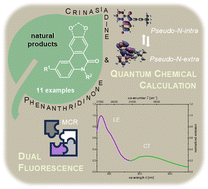
The sequential concatenation of Buchwald–Hartwig amination, Suzuki coupling, and lactamization in a consecutive palladium-catalyzed three-component synthesis provides direct access to functionalized N-arylsubstituted phenanthridinones and alkaloid-analogous crinasiadines starting from simple, readily available ortho-bromoanilines. A modified reaction sequence, consisting of Suzuki coupling, amide bond formation (lactamization), and subsequent alkylation at the amide nitrogen, provides N-alkylsubstituted phenanthridinones and crinasiadines, including two natural products, which are known for their cytotoxic activity against various cancer cell lines. A comprehensive investigation of the photophysical properties reveals dual emission of the N-aryl substituted derivatives, characterized by locally excited states (LE band) and intramolecular charge transfer states (CT band). Quantum chemical calculations rationalize the dual emission and suggest that the LE band derives from the pseudo-N-intra conformation, whereas the CT band arises from the pseudo-N-extra conformation in the excited state.
 Please wait while we load your content...


