


 PLATFORM UPDATE:


Sustainable valorisation of wastewater sludge into activated carbon for permanganate adsorption and reuse in supercapacitors

Abstract
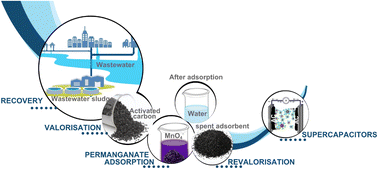
Wastewater sludge from treatment processes was valorised into activated carbon via carbonisation, followed by chemical activation using orthophosphoric acid (H3PO4) and tagged H-WSAC. The H-WSAC was employed as an adsorbent in the removal of permanganate ions (MnO4−) from water, achieving a maximum adsorption capacity of 78.36 mg g−1 at an initial concentration of 100 mg L−1. Adsorption kinetics followed a pseudo-second-order model (R2 = 0.9754), indicating chemisorption, and equilibrium data fitted the Langmuir isotherm (R2 = 0.974), suggesting monolayer adsorption. The physicochemical properties of pristine (H-WSAC) and spent (Mn-WSAC) adsorbents were characterised by Fourier-transform infrared spectroscopy, Raman spectroscopy, X-ray diffraction, scanning electron microscopy coupled with energy-dispersive X-ray spectroscopy, and transmission electron microscopy. The captured Mn species subsequently act as redox-active sites, facilitating the transition from water treatment to energy storage. The spent adsorbent, Mn-WSAC, was revalorised as an electrode material for supercapacitors. The symmetric supercapacitor using Mn-WSAC in a 1 M H2SO4 electrolyte exhibited a specific capacitance of 102 F g−1, an energy density of 14.16 Wh kg−1, and a power density of 1000 W kg−1 at a current density of 0.5 A g−1, while retaining 83.15% of its initial capacitance over 15 000 cycles. This study offers a sustainable approach to wastewater sludge management by converting sludge into activated carbon for water purification and subsequent energy storage applications.
 Please wait while we load your content...


