


 PLATFORM UPDATE:


Study on the performance of emulsion explosives sensitized by an oxygen-generating M foaming agent

Abstract
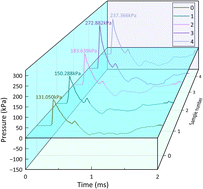
To address the limitation of traditional nitrogen-sensitized emulsion explosives, which only produce a hot-spot effect without contributing energy, this study proposes an energy synergy enhancement strategy based on oxygen sensitization. By utilizing the oxygen generated from the reaction of an M foaming agent at varying concentrations to sensitize the emulsion explosives, with conventional emulsion explosives as a control group, the explosion performance was systematically evaluated through detonation velocity and air blast experiments. The influence on thermal decomposition properties was investigated via TG-DSC tests by fitting kinetic parameters. The results indicate that compared to the sodium nitrite control group, the mean detonation velocity of the M foaming agent-sensitized system increased from 4280 m s−1 to 4360 m s−1, reaching a peak of 4664 m s−1 at a 0.6% additive amount—an increase of 9%. The energy release characteristics exhibited significant concentration dependence: the peak overpressure (272.88 kPa) in air blast tests for the system with 0.6% M foaming agent was 81.5% higher than that of the 0.2% system, and the positive impulse increased by 62%. TG-DSC tests revealed that the peak thermal decomposition temperature of the M foaming agent-sensitized emulsion explosives generally shifted to higher temperatures with increasing additive amount, and the apparent activation energy also increased, indicating enhanced thermal stability. The chemical sensitization-energy synergy mechanism established in this study provides a novel approach for developing high-energy, high thermal stability emulsion explosives.
 Please wait while we load your content...


