Issue 52, 2025

Interrelated lithium-ion transport, NTCR behavior, and dielectric-optical coupling in multifunctional Li3Mg2NbO6 ceramic

Abstract

The rapid progress of 5G/6G communication and advanced radar systems demands dielectric ceramics with excellent microwave performance and multifunctional characteristics. Lithium-based Li3Mg2NbO6 (LMN), crystallizing in a rock-salt-derived orthorhombic structure, is identified as a promising candidate due to its structural stability and tunable dielectric response. LMN ceramics were synthesized by the solid-state route and comprehensively analyzed using X-ray diffraction, UV-Vis spectroscopy, and impedance spectroscopy. The material exhibits a direct bandgap of 3.78 eV, indicating potential for optoelectronic and photocatalytic applications, while an Urbach energy of 0.92 eV reveals structural disorder affecting charge transport. Impedance results confirm thermally activated hopping conduction with an activation energy of 1.16 eV, governed by non-Debye relaxation associated with defect-mediated mechanisms. The strong correlation between structure, optical properties, and charge dynamics highlights LMN as a versatile, high-performance ceramic for next-generation microwave and UV-responsive electronic devices.
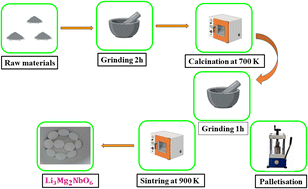
Graphical abstract: Interrelated lithium-ion transport, NTCR behavior, and dielectric-optical coupling in multifunctional Li3Mg2NbO6 ceramic

Article information

Article type
Paper
Submitted
06 Sep 2025
Accepted
28 Oct 2025
First published
17 Nov 2025
This article is Open Access
Creative Commons BY-NC license

RSC Adv., 2025,15, 44623-44636

Interrelated lithium-ion transport, NTCR behavior, and dielectric-optical coupling in multifunctional Li3Mg2NbO6 ceramic

S. Aydi, M. M. Bouzayani, M. Boukriba, S. Nasri, O. Radhi Alzoubi and A. Oueslati, RSC Adv., 2025, 15, 44623 DOI: 10.1039/D5RA06717K

This article is licensed under a Creative Commons Attribution-NonCommercial 3.0 Unported Licence. You can use material from this article in other publications, without requesting further permission from the RSC, provided that the correct acknowledgement is given and it is not used for commercial purposes.

To request permission to reproduce material from this article in a commercial publication, please go to the Copyright Clearance Center request page.

If you are an author contributing to an RSC publication, you do not need to request permission provided correct acknowledgement is given.

If you are the author of this article, you do not need to request permission to reproduce figures and diagrams provided correct acknowledgement is given. If you want to reproduce the whole article in a third-party commercial publication (excluding your thesis/dissertation for which permission is not required) please go to the Copyright Clearance Center request page.

Read more about how to correctly acknowledge RSC content.

Social activity

Spotlight

Advertisements