


 PLATFORM UPDATE:


The effective remediation of heavy metal-laden wastewater by employing cement dust derived from industrial activities as a sorbent
 *a
*a
Abstract
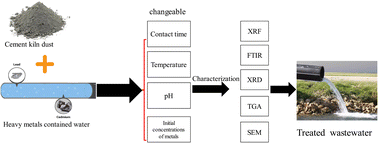
As a continuation of our earlier study, “The effective treatment of dye-containing simulated wastewater by using the cement kiln dust as an industrial waste adsorbent”, the present work investigates the purification of wastewater containing heavy metals (HMs) using the industrial waste byproduct, cement kiln dust (CKD), on both laboratory and industrial scales. The adsorption of HMs was investigated through isothermal equilibrium batch experiments. This study primarily focused on detecting and removing traces of lead (Pb) and cadmium (Cd), with the removal process examined using X-ray fluorescence, scanning electron microscopy, Fourier-transform infrared spectroscopy, thermogravimetric analysis, and X-ray diffractometry techniques. The adsorption of both metals was examined under varying contact times, pH levels, temperatures, and several initial concentrations of Pb and Cd. The results revealed that maximum sorption was acquired after 80 minutes at pH 8 and 55 °C. Linear and nonlinear pseudo-first-order, pseudo-second-order, and intraparticle diffusion kinetic models were employed. The best fit of the kinetic data was achieved using the pseudo-second-order model, with a regression coefficient (R2) of 0.997. Analyzing the thermodynamic parameters revealed that the adsorption activity was endothermic and energetically favorable. The adsorption process was found to be the formation of a homogeneous monolayer/heterogeneous multilayer spread over the points of activation of the CKD grains, as detected from the analysis of the linear/nonlinear patterns of the Langmuir and Freundlich isotherms, with preference for the Freundlich model in describing the adsorption process based on its higher R2. The adsorption capacities were 403.7 and 362.54 mg g−1, respectively, for the Pb and Cd metals. A real industrial wastewater sample was treated with CKD to assess the removal process, and the HMs removal efficiency was found to be between 86.70 and 90.77%. CKD as an adsorbent has not been extensively studied before; however, all the findings revealed that it is a very low-cost adsorbent and that it is practical for the powerful elimination of HM contamination from real and/or simulated industrial wastewater.
 Please wait while we load your content...


