Issue 53, 2025, Issue in Progress

Exploring recent advances and synthesis strategies in conductive polymers and their composites in supercapacitor systems: a comprehensive review

Abstract

The expansion of industry has led to increased environmental pollution and irreparable damage to the ecosystem. Supercapacitors (hybrid capacitors) have been introduced as renewable energy sources with high power density and energy density. Conducting polymers were introduced as pseudocapacitor electroactive materials. Conducting polymers have advantages, including high stability during alternating charge–discharge cycles, high conductivity, and corrosion resistance. Preparing conductive polymer-based composites with other electroactive materials (MOFs, TMS, C, TMO, and MXene) due to synergistic effects leads to the achievement of high-performance hybrid electrode materials. The electrochemical performance of these composites varied depending on the type of electroactive materials (MOFs, TMS, C, TMO, and MXene), the type of conductive polymer, and the synthesis method. In this study, an attempt was made to provide a basis for researchers to conduct innovative studies by reviewing the synthesis methods, supercapacitor studies conducted on various conductive polymers, and composites based on conductive polymers.
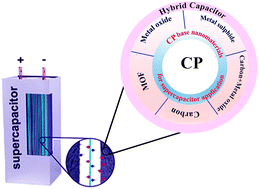
Graphical abstract: Exploring recent advances and synthesis strategies in conductive polymers and their composites in supercapacitor systems: a comprehensive review

Article information

Article type
Review Article
Submitted
02 Sep 2025
Accepted
24 Oct 2025
First published
19 Nov 2025
This article is Open Access
Creative Commons BY-NC license

RSC Adv., 2025,15, 45245-45267

Exploring recent advances and synthesis strategies in conductive polymers and their composites in supercapacitor systems: a comprehensive review

A. Aldulaimi, S. M. Saeed, S. V. Menon, R. Y. Saber, S. Ray, K. Jayabalan, A. Sinha, R. Sharma, W. M. Taher and M. Alwan, RSC Adv., 2025, 15, 45245 DOI: 10.1039/D5RA06603D

This article is licensed under a Creative Commons Attribution-NonCommercial 3.0 Unported Licence. You can use material from this article in other publications, without requesting further permission from the RSC, provided that the correct acknowledgement is given and it is not used for commercial purposes.

To request permission to reproduce material from this article in a commercial publication, please go to the Copyright Clearance Center request page.

If you are an author contributing to an RSC publication, you do not need to request permission provided correct acknowledgement is given.

If you are the author of this article, you do not need to request permission to reproduce figures and diagrams provided correct acknowledgement is given. If you want to reproduce the whole article in a third-party commercial publication (excluding your thesis/dissertation for which permission is not required) please go to the Copyright Clearance Center request page.

Read more about how to correctly acknowledge RSC content.

Social activity

Spotlight

Advertisements