


 PLATFORM UPDATE:


Sustainable zeolite/activated carbon nanocomposite for dual-dye adsorption, kinetic and thermodynamic studies, and urea electro-oxidation applications

Abstract
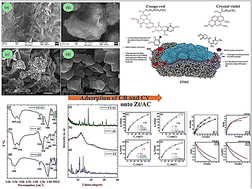
This study developed a novel zeolite/activated carbon nanocomposite (Zeo/AC) for the simultaneous removal of carcinogenic Congo Red (CR) and Crystal Violet (CV) dyes, with subsequent energy recovery. The material was synthesized via a green ball milling-hydrothermal method and characterized thoroughly. The Zeo/AC nanocomposite demonstrated exceptional adsorption performance, achieving record capacities of 752.6 mg g−1 for CR and 908.3 mg g−1 for CV at 55 °C and neutral pH. Adsorption was rapid, reaching equilibrium within 60 minutes and following pseudo-second-order kinetics (R2 > 0.998). The process was endothermic and spontaneous. The intermediate pHpzc (6.1) enabled efficient dual-dye removal via synergistic mechanisms: electrostatic attraction for cationic CV and π–π stacking/pore filling for anionic CR. Statistical physics modeling confirmed physisorption-dominated interactions (ΔE ≈ −12 kJ mol−1). The composite exhibited excellent regenerability, retaining >82% capacity over five cycles. As a proof-of-concept for a circular economy, the dye-saturated adsorbent was successfully repurposed as an electrode for urea electro-oxidation, delivering a current density of 15.45 mA cm−2. The synthesis method and application were validated as environmentally friendly by greenness assessment tools (AGREEprep, BAGI, RGB12). This work presents a sustainable, dual-function material for advanced wastewater treatment and resource valorization.
 Please wait while we load your content...


