


 PLATFORM UPDATE:


Pyrolysis behaviours and kinetics study of corn ethanol industry co-product towards its bioenergy potential
 *b
and
*b
and
Abstract
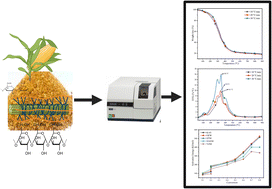
Distillers Dried Grains with Solubles (DDGS) is a promising bioenergy feedstock owing to its abundant availability and rich organic composition. This study investigates the pyrolysis behaviour of DDGS using thermogravimetric analysis (TGA) at heating rates of 10, 20, and 30 °C min−1 to determine its kinetic and thermodynamic parameters. Model-free methods such as Kissinger–Akahira–Sunose (KAS), Flynn–Wall–Ozawa (OFW), Starink (STM), and Vyazovkin (VZM), along with model-fitting approaches such as Coats-Redfern (CR) and Distributed Activation Energy Model (DAEM), were employed to estimate the kinetic parameters. The apparent activation energy (Ea) varied significantly with conversion (α), ranging from 82 to 525 kJ mol−1 across different models, confirming the multi-step nature of pyrolysis. Further, CR fitting yielded lower activation energy values of 36.34 and 39.32 kJ mol−1 biomass at reaction orders between 1.0 and 2.7. Thermodynamic analysis revealed that enthalpy (ΔH) increased from 84 to 520 kJ mol−1 as conversion progressed from 0.1 to 0.8, while Gibbs free energy (ΔG) remained positive (87–233 kJ mol−1), indicating a non-spontaneous process requiring external energy. Further, the entropy (ΔS) shifted from negative values at low conversions (−111 J mol−1 K−1) to highly positive values at higher conversions (up to 573 J mol−1 K−1), reflecting increasing molecular disorder. This trend suggests that the later stages of pyrolysis are dominated by lignin degradation and associated structural changes. The obtained results confirm that DDGS pyrolysis follows a complex, multi-step pathway influenced by biochemical composition and inherent minerals. Further, the present study aligns with Sustainable Development Goals (SDGs) 6, 7, 13, 14 and 15.
 Please wait while we load your content...


