


 PLATFORM UPDATE:


ABA triblock copolymers prepared with poly(ε-caprolactone) and PEG, PTHF, and PPG macroinitiators as the central segment: synthesis, characterization, and thermal properties
 a
Gerardo González
García,
a
José Bonilla
Cruz,
b
Kenneth J.
Shea
c
and
José E.
Báez
*a
a
Gerardo González
García,
a
José Bonilla
Cruz,
b
Kenneth J.
Shea
c
and
José E.
Báez
*a
Abstract
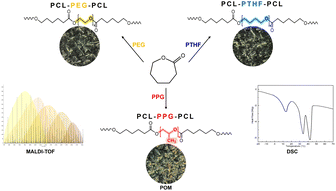
A total of 36 ABA-type triblock copolymers were synthesized via ring-opening polymerization (ROP) of ε-caprolactone (CL) using three different macroinitiators as segment B: poly(ethylene glycol) (PEG), poly(tetrahydrofuran) (PTHF), and poly(propylene glycol) (PPG). A range of molecular weights (Mn = 200–1000 g mol−1) and degrees of polymerization (DP) were used for segment A (DP = 5, 10, 15, and 20). MALDI-TOF analysis of the triblock copolymers revealed complexity in the pattern of the molecular weight distribution, where each DP of segment A (PCL) corresponded to a specific molecular weight distribution of segment B. Additionally, end group analysis indicated an α,ω-hydroxytelechelic species, which was supported by MALDI-TOF and 1H NMR studies. Increases in the DP of PCL segments resulted in higher melting temperatures (Tm) and enthalpies of fusion (ΔHm), suggesting that crystallinity increases in a proportional manner. The influence of the B segment on the PCL segment was evidenced by a decrease of enthalpy and thus crystallinity, which was attributed to the disruption of the polyether segment generating amorphous domains in the PCL segment. Poly(ester urethane)s (PEUs) derived from ABA triblock copolymers showed plastic behavior with relatively poor mechanical properties.
 Please wait while we load your content...


