


 PLATFORM UPDATE:


Towards advanced remediation: CuS/CdS Z-scheme heterojunction with accelerated charge-transfer for efficient photocatalytic degradation of trypan blue

Abstract
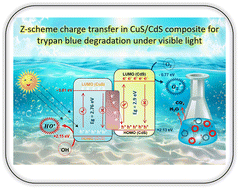
This study involves the preparation of virgin CuS and CdS for comparative analysis, followed by the synthesis of a CuS/CdS heterojunction nanocomposite using co-precipitation and subsequent annealing. The structural and compositional investigations (XRD, FTIR, SEM, and EDX) verified high purity and the successful production of a heterojunction with hexagonal crystal phases. Characterization of electrical (I–V), optical (UV-Vis), and optoelectronic (photocurrent) properties demonstrated enhanced charge separation, a reduced band gap (2.52 eV), and augmented visible-light absorption in the composite. In comparison to its equivalents, the CuS/CdS exhibited significantly enhanced electrical conductivity (3.60 × 10⁻⁴ S m−1), facilitating reduced recombination and accelerated charge transfer. The efficacy of the photocatalytic process was assessed using trypan blue, a stable commercial azo dye. The dye was completely eliminated by the CuS/CdS composite in 48 minutes through photocatalytic degradation (81%) and 15 minutes through adsorption (19%). The kinetic rate constant of 0.039 min−1 was 2.79 and 1.86 times greater than that of CdS and CuS, respectively. Post-cycle XRD analysis confirmed structural stability, and reusability studies over six cycles indicated an efficiency decrease of only 2.3%. The scavenger experiments indicated that superoxide radicals (˙O2−) exhibited the highest reactivity among the species tested. Calculations of band edge potential have verified that the Z-scheme charge transfer mechanism facilitates efficient charge separation and the generation of reactive oxygen species (ROS). Curiously, the pH of the heterogeneous composite was found to be correlated with its photocatalytic activity. An examination of the pH level disclosed a PZC value of 5.39. The composite functioned most effectively at a pH of 4. A novel CuS/CdS composite has been explored that is not only novel but is also ecological, cost-effective, and structurally stable in mineralizing the persistent azo dyes.
 Please wait while we load your content...


