Issue 48, 2025

Research on developing SERS substrates based on a ZnO porous membrane decorated with silver nanoparticles aimed at detecting low concentrations of Rhodamine B

Abstract

Recently, Ag-decorated ZnO has been explored for detecting the residual organic toxins through surface-enhanced Raman scattering (SERS), based on the local surface plasmonic resonance (LSPR) effect. In this study, we presented the composite of Ag/ZnO nanoparticles with a porous structure, supported by polystyrene (PS), for fabricating SERS substrates to detect Rhodamine B (RhB) at low concentration. In this structure, Ag nanoparticles (NPs) enhance the Raman signals via the electromagnetic mechanism (EM), while ZnO contributes to signal enhancement through the chemical mechanism (CM). PS microspheres improve the adhesion of Ag/ZnO on substrates and enable the formation of a porous structure in the membrane. At an excitation wavelength of 532 nm, the SERS intensity of RhB at 1645 cm−1 exhibits a linear relationship with RhB concentration. The limit of detection (LOD) and enhancement factor (EF) for the porous Ag/ZnO structure are calculated to be 7.9 × 10⁻⁶ ppm and 3.08 × 10⁶, respectively. The innovative porous architecture is advantageous for Raman signal generation and therefore well-suited for detecting residual organic toxins in agricultural products.
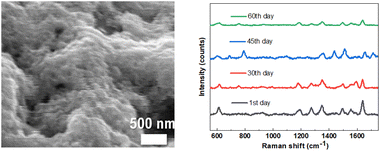
Graphical abstract: Research on developing SERS substrates based on a ZnO porous membrane decorated with silver nanoparticles aimed at detecting low concentrations of Rhodamine B

Supplementary files

Transparent peer review

To support increased transparency, we offer authors the option to publish the peer review history alongside their article.

View this article’s peer review history

Article information

Article type
Paper
Submitted
20 Aug 2025
Accepted
15 Oct 2025
First published
29 Oct 2025
This article is Open Access
Creative Commons BY-NC license

RSC Adv., 2025,15, 40846-40854

Research on developing SERS substrates based on a ZnO porous membrane decorated with silver nanoparticles aimed at detecting low concentrations of Rhodamine B

T. N. T. Nguyen, N. T. H. Nguyen, M. K. Tran, H. N. Luong, L. T. Duy, H. D. Tong, T. T. Pham and V. Q. Dang, RSC Adv., 2025, 15, 40846 DOI: 10.1039/D5RA06188A

This article is licensed under a Creative Commons Attribution-NonCommercial 3.0 Unported Licence. You can use material from this article in other publications, without requesting further permission from the RSC, provided that the correct acknowledgement is given and it is not used for commercial purposes.

To request permission to reproduce material from this article in a commercial publication, please go to the Copyright Clearance Center request page.

If you are an author contributing to an RSC publication, you do not need to request permission provided correct acknowledgement is given.

If you are the author of this article, you do not need to request permission to reproduce figures and diagrams provided correct acknowledgement is given. If you want to reproduce the whole article in a third-party commercial publication (excluding your thesis/dissertation for which permission is not required) please go to the Copyright Clearance Center request page.

Read more about how to correctly acknowledge RSC content.

Social activity

Spotlight

Advertisements