


 PLATFORM UPDATE:

Ab initio quantum transport investigation of Sub-3 nm β-InSe transistors for future high-performance nanoelectronics
 *c
*c
Abstract
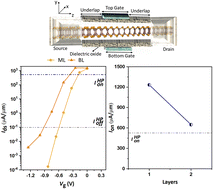
Recently, field-effect transistors (FETs) based on triple-layer InSe have been experimentally fabricated with a channel length of 10–20 nm. They show better performance than Si FETs in terms of transconductance and room-temperature ballistic ratio. Their device performance limits at shorter physical lengths remain to explore. We used the ab initio quantum transport simulation method to study monolayer (ML) and bilayer (BL) n-type β-InSe FETs with gate lengths (Lg) of 2 and 3 nm. The on-state current (Ion) values of the ML and BL n-type β-InSe FETs at both 2 and 3 nm Lg can achieve the International Roadmap Technology for Semiconductors (ITRS) high-performance (HP) device standards. Specifically, the devices achieve Ion values of 1236 and 648 μA μm−1 at Lg = 2 nm for the ML and BL n-type β-InSe FETs, respectively, surpassing the standard on-state current (528 μA μm−1) defined in the 2013 ITRS edition for HP applications. The power-delay product (power consumption), delay time, and energy-delay product (energy consumption) of ML and BL n-type β-InSe also meet the ITRS requirements for HP applications. The ML and BL n-type β-InSe FETs can be potential candidates for future electronics at sub-3 nm physical nodes.
 Please wait while we load your content...


