


 PLATFORM UPDATE:


Single-layer biosensor for urinary prostate-cancer biomarkers through transition-metal-doped graphene: a DFT study
 a
and
Xuan
Luo
a
a
and
Xuan
Luo
a
Abstract
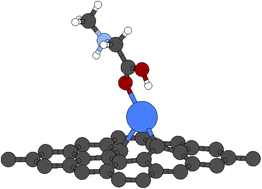
Early, non-invasive detection of prostate cancer (PCa) remains a major clinical challenge, as current screening methods carry significant drawbacks. Biosensors targeting urinary PCa biomarkers offer a promising alternative. Motivated by the recurrent appearance of sarcosine and furan-3-methanol in urinary volatilomics, and by the growing application of 2D nanomaterials in metabolite detection, we employed first-principles calculations to investigate pristine graphene and gold-, palladium-, and silver-doped graphenes as potential single-layer biosensors. We compared atomic optimizations, adsorption energies, band-gap shifts, charge-density differences, recovery times, conductivity changes, and theoretical sensing responses to identify the most effective sensor. Our results revealed that pristine graphene fails to adsorb either molecule; Au-doping binds sarcosine strongly but inadequately retains furan-3-methanol; Pd-doping leads to insufficient retention for both analytes; and Ag-doping enables rapid desorption of furan-3-methanol yet provides optimal sensing for sarcosine. Overall, Ag-doped graphene demonstrates strong potential as a room-temperature sensor for sarcosine, while detecting furan-3-methanol will require alternative chemistries or device architectures.
 Please wait while we load your content...


