


 PLATFORM UPDATE:


Microwave-assisted multi-component green synthesis of bioactive pyrazol-5-ol and its derivatives using graphene oxide as a recyclable catalyst: a route to EGFR inhibitors

Abstract
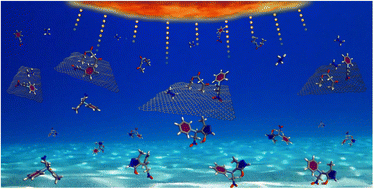
Traditional methods for synthesizing heterocyclic compounds often involve multistep procedures and harsh conditions, leading to environmental concerns and inefficient use of resources. Herein, a sustainable and rapid microwave-assisted multi-component reaction (MCR) strategy was developed for the synthesis of 3-methyl-4-(2-nitro-1-phenylethyl)-1H-pyrazol-5-ol (4) using graphene oxide (GO) as a heterogeneous catalyst in various polar solvents. Under optimized conditions (180 W, 4 min, 0.05 wt% GO in water), the reaction afforded up to 95% yield. GO, synthesized via a modified Hummers' method, exhibited excellent catalytic efficiency and reusability over five consecutive cycles with minimal loss of activity. Structural analyses (XRD, XPS, Raman, FT-IR, TGA, and TEM) revealed that GO retained its nanoscale flake-like morphology (∼5–9 nm crystallite size), few-layered sheet structure, and partially ordered graphitic domains even after repeated microwave exposure, confirming its thermal and structural stability. The optimized protocol efficiently accommodated various substituted reactants, yielding pyrazol-5-ol derivatives (4, 6 and 8 series) in the range of 80–96%. Computational docking of all synthesized compounds against EGFR tyrosine kinase (PDB ID: 1M17) showed favourable π–π stacking and hydrogen bonding interactions, while compound 6a exhibited the strongest binding affinity and potent cytotoxicity toward human lung cancer (A549) cells (IC50 = 15.29 μM). This green, fast, and reusable GO-catalysed MCR approach offers a promising route for the sustainable development of EGFR-targeted anticancer agents.
 Please wait while we load your content...


