


 PLATFORM UPDATE:


Determination of the light matter interaction and thermal heat conversion efficiency of K2TlAsZ6 (Z = F, Cl, Br, and I) using a DFT approach
 *a
*a
Abstract
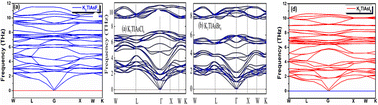
Double perovskites have garnered significant attention as promising alternatives for sustainable energy solutions owing to their structural versatility and potential for integration into optoelectronic technologies. Halide double perovskites K2TlAsZ6 (Z = F, Cl, Br, and I) were systematically studied using density functional theory to assess their potential for optoelectronic and thermoelectric applications. Calculations were performed using the FP-LAPW + lo method, confirming structural and thermodynamic stability via formation energy, and the Goldschmidt's tolerance factor. The electronic structure calculations using the TB-mBJ + SOC potential revealed direct bandgaps ranging from 3.25 eV (Z = F) to 0.37 eV (Z = I), with significant UV absorption observed in the optical spectra. Thermoelectric performance versus chemical potential, evaluated via the Boltzmann transport theory, showed promising ZT values approaching 1.0 at 1000 K. Additionally, negative Gibbs free energy and increasing entropy with temperature indicate good thermal stability. These results suggest that K2TlAsZ6 compounds are promising materials for next-generation optoelectronic and thermoelectric devices.
 Please wait while we load your content...


