


 PLATFORM UPDATE:


Data-driven exploration of Na–Bi compounds: a first-principles and machine learning approach to topological thermoelectrics

Abstract
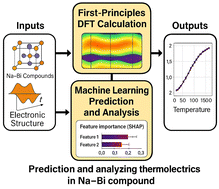
We conduct an in-depth investigation of the structural, electronic, vibrational, thermodynamic, and thermoelectric characteristics of Na–Bi-based compounds, specifically tetragonal NaBi, hexagonal NaBi3, and cubic Na3Bi, using advanced first-principles calculations in conjunction with machine learning (ML) models. We used density functional theory (DFT) with spin–orbit coupling (SOC) to figure out the electronic structure, phonon dispersions, and thermoelectric transport using Boltzmann transport theory. Our findings validate the Dirac semimetal nature of cubic Na3Bi and demonstrate varied topological and thermodynamic properties within the Na–Bi family. To speed up the prediction of the thermoelectric figure of merit (ZT) while enhancing interpretability to understand at the feature level, we trained supervised ML models [Random Forest (RF) and Neural Network (NN)] on thermoelectric results from DFT. It is possible to directly compute the figure of merit (ZT) from DFT-derived transport coefficients such as the Seebeck coefficient, electrical conductivity, and thermal conductivity. However, machine learning (ML) models serve as powerful surrogate predictors, enabling rapid screening of derivative compounds and quantitative assessment of feature importance through SHAP (SHapley Additive exPlanations) analysis. At low temperatures, RF models consistently outperformed NN models, but both performed well at high temperatures. SHAP analysis showed that the Seebeck coefficient has the biggest effect on ZT in all regimes. This integrated, physics-informed, and data-driven methodology demonstrates that machine learning can significantly augment first-principles approaches. It accelerates predictions, guides feature prioritisation, and enhances design capabilities. The developed workflow provides a generalizable and interpretable framework for the predictive modeling of advanced topological thermoelectric materials.
 Please wait while we load your content...


